Divine Office
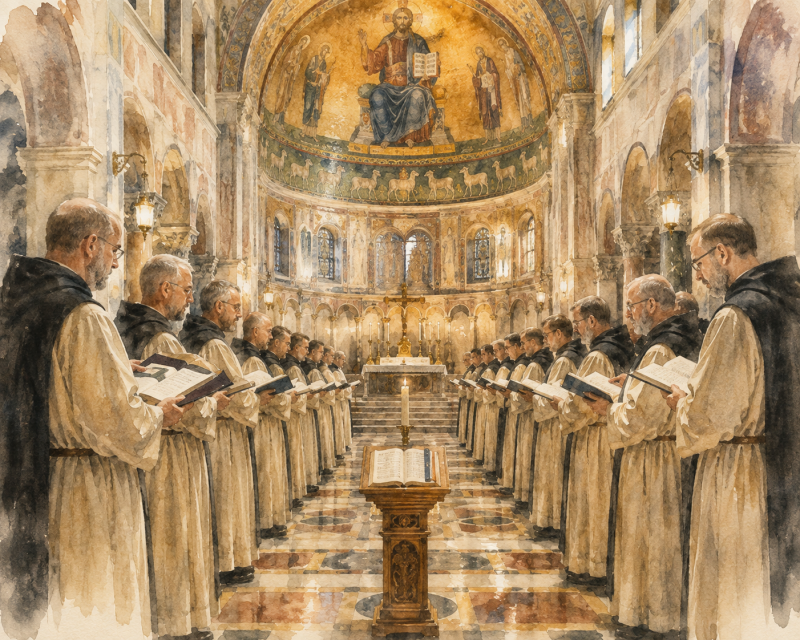
The Divine Office, also called the Liturgy of the Hours, is the daily prayer of the whole Church. Through it, Catholics throughout the world join together in prayer at different times of the day, by praying the Psalms. The Church calls it “the public and common prayer of the Church” and “the prayer of Christ with his body, the Church.” Flowing from the Eucharist, it carries the prayer of Christ into the hours of our day, sanctifying our work, rest, joys, and ordinary activities (Compendium of the Catechism of the Catholic Church, 243).
Priests and deacons are obligated to pray the Liturgy of the Hours, and it also has an important place in consecrated life. But the Divine Office isn't only for priests and religious—laypeople are invited to pray it, too. It is a beautiful way to join your own daily prayer to the prayer of the entire Church.
"Sing the Hours" with Paul Rose: singthehours.org
"Daily practice of this liturgical prayer, which is steeped in the richness of Sacred Scripture, will give Christians authentic spiritual food, sanctify their days, and unite them more closely with the Church throughout the world." (singthehours.org)
Praying the Divine Office/Liturgy of the Hours:
-Deepens your relationship with Christ.
-Binds you to the faithful of every time and place.
-Sanctifies the day through the sacrifice of praise.
Helpful Links:
What is the Divine Office/Liturgy of the Hours? https://www.usccb.org/prayer-and-worship/liturgy-of-the-hours
Explanation from The Catechism of the Catholic Church
Updates that are coming.
Learn about and pre-order a revised breviary (from Ascension Press).
A Beginner's Guide to the art of praying the Divine Office (by Philip Kosloski)
Teaching (pdf) by Deacon David Ochoa
Helpful Charts and Overviews Compiled by Fr. Felix Just, S.J., Ph.D.
General Instructions from England, Wales, and Ireland (pdf)
Pray the Divine Office online https://divineoffice.org/
Prayer at Conception Abbey
The Divine Office/Liturgy of the Hours, even after reviewing these helps and explanations, can be confusing. Word on Fire, the ministry of Bishop Robert Barron, has created a user-friendly series of booklets to help lay-people easily join in this beautiful prayer of the Church. Go here for more information: https://www.wordonfire.org/pray/
A Helpful Book and Website:
Breviary Bootcamp: (an easy-to-understand blog by Daria Sockey—though no longer updated)
Daria's book: The Everyday Catholic's Guide to the Liturgy of the Hours
Daria says: Many people only pray one or two of the liturgical hours each day rather than all five. The two principle hours are Morning Prayer and Evening Prayer, and these are what the Church recommends to lay people above all the others. (Don't let the term "hours" scare you. It only takes a few minutes to recite each one.)
Go here→ for Daria's "collection of posts that explain how we must learn to think as we pray the psalms. It includes discussions of some of the things we might not like about the psalms at first, for example, when they are violent, or express emotions that we are not feeling. These posts will show you how to learn from these obstacles and turn them into fruitful prayer. Another post discusses what the point is in praising God so much. Another talks about the poetic structure of the psalms. There's not particular order of importance here. Just scroll down through the boldface topics and read the ones that pique your interest."
"No one should hesitate to be creative in giving a psalm a "title" distinctly ones's own; such a practice has the potential to draw the one who prays into the rich world of meaning that the Psalms have borne for both church and synagogue for thousands of years. Make each psalm special to you, yourself."
Gregory J. Polan, OSB, The Psalms: Songs of Faith and Praise